Sewer Line Repair or Replacement: How to Compare Your Options
Sewer line repair fits localized, accessible damage, while replacement suits widespread failure or a badly deteriorated pipe. PlumbingKentwa.link uses camera findings, pipe condition, access, and repair method to guide the recommendation. Our team explains the findings and prepares a clear project scope.
Request an EstimateWhat Is the Difference Between Sewer Line Repair and Replacement?
Sewer line repair restores a damaged section, while sewer line replacement removes and renews part or all of the failed line.
Repair usually targets localized damage, such as a cracked pipe or broken joint. Replacement suits widespread pipe failure, severe deterioration, or a collapsed sewer line.
Both options can address sewer backups, slow drains, sewage odors, and repeated blockages. The right choice depends on the pipe condition and the repair access available.
How Do You Know Whether a Sewer Line Needs Repair or Replacement?
A sewer camera inspection shows whether damage is localized enough for repair or severe enough to support replacement.
Our team reviews the camera findings inside the sewer line. We look for cracks, root intrusion, blockages, offset joints, and pipe collapse.
Pipe location also matters. A stable pipe with reachable damage may support a spot repair. A badly damaged line may need replacement even when one problem area appears easy to reach.
Our Sewer Camera Inspection service helps connect visible symptoms with the actual pipe condition.
What We Check Before Recommending a Sewer Line Option
These checks help us define the repair scope or replacement scope. They also help us explain property disruption before work begins.
When Can a Sewer Line Be Repaired Instead of Replaced?
Sewer line repair can suit a localized defect when the surrounding pipe remains stable and the damaged area can be reached.
A spot repair may fit a localized crack, a single damaged joint, or root intrusion near one section. The rest of the line must still have enough strength and reliable connections.
Repair access can come from an exposed section, a cleanout, or another suitable access point. Our team checks the surrounding pipe before limiting the work to one area.
Repair may not solve the problem when deterioration is widespread. Repeated backups, multiple damaged sections, or a collapsed sewer line can point toward a broader replacement scope.
How Do Sewer Line Repair and Replacement Compare?
Sewer line repair and sewer line replacement differ mainly in damage scope, excavation needs, and future risk.
We compare the pipe condition with the property layout before recommending either option. The table shows how each approach generally fits different project needs.
| Factor | Sewer line repair | Sewer line replacement |
|---|---|---|
| Damage scope | Localized crack, joint, or other reachable defect | Widespread deterioration, collapse, or repeated failure |
| Excavation | Often limited to the damaged area or access point | May involve a larger work area along the failed line |
| Pipe lifespan | Keeps stable sections in place | Renews part or all of the underground sewer line |
| Property disruption | May be more limited when access is simple | May require more excavation and surface restoration |
| Future risk | Depends on the condition of the remaining pipe | Can reduce risk across the replaced section |
These are planning comparisons, not automatic outcomes. Camera findings, pipe material, access, and ground conditions determine the practical choice.
What Is the Difference Between Pipe Lining and Pipe Bursting?
Pipe lining creates a new pipe inside the existing line, while pipe bursting breaks the old line and pulls a new pipe through its path.
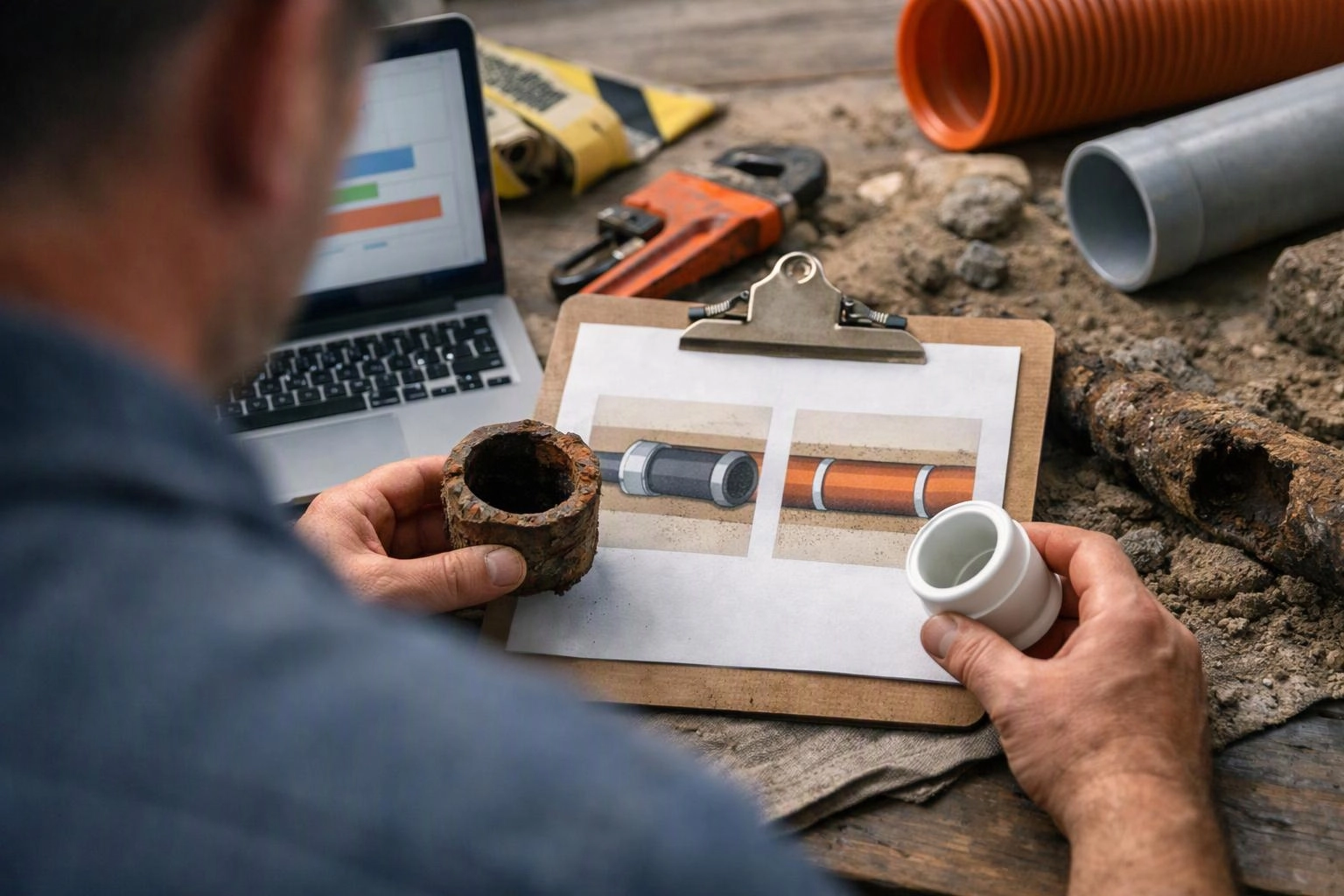
Pipe lining uses a cured-in-place pipe that forms within the existing sewer pipe. The method can suit a line with a usable path and suitable structure.
Pipe bursting uses access pits and a pulling head to break the old pipe. The new pipe follows the existing path, so the method needs enough space and suitable ground conditions.
Both methods fall under trenchless sewer repair. Our team checks pipe size, connections, bends, access points, and surrounding conditions before selecting a method.
Does Trenchless Sewer Repair Require Digging?
Yes, trenchless sewer repair usually needs limited access openings, but the exact digging depends on the pipe layout and selected method.
Pipe lining may use existing cleanouts or small access openings. Pipe bursting commonly needs access pits at suitable points along the line.
Trenchless work can reduce yard disruption, but it doesn't remove every excavation or surface restoration need. Our team explains the expected access work before preparing the project quote.
What Changes the Cost of Repairing or Replacing a Sewer Line?
The cost depends on the damage, pipe location, access, selected method, materials, and restoration work; we provide an exact quote after evaluating the line.
Pipe depth and pipe length can affect excavation and labor needs. Soil conditions can also change how the work area must be supported and restored.
Trenchless methods may change the work scope because they use different equipment, access points, and replacement materials. Traditional excavation may require more surface restoration when the line runs below finished areas.
Our quote explains the recommended method, repair scope or replacement scope, access work, materials, and surface restoration. Contact us for a project-specific quote after the sewer line evaluation.
What Happens During a Sewer Line Repair or Replacement Project?
Our sewer line process starts with camera evidence and ends with a post-work inspection.
Each step connects the diagnosis to the selected repair or replacement method. We explain changes in scope before work proceeds.
Our team also explains property access and expected disruption before the project starts. That gives you a clear basis for approving the work.
Which Sewer Line Option Fits Your Situation?
The right option depends on whether damage is localized, whether the pipe remains stable, and which method suits the property.
Localized damage with stable surrounding pipe may support a spot repair. Extensive deterioration, repeated backups, or pipe collapse may support traditional replacement or a trenchless method.
Property access can influence the choice as much as pipe condition. Our team weighs access points, ground conditions, surface restoration, and long-term reliability together.
A camera-led recommendation helps avoid choosing a method based only on symptoms. The visible problem may not show the full condition of the underground sewer line.
How PlumbingKentwa.link Helps You Choose the Next Step
We use a sewer camera inspection to connect visible symptoms with the actual condition of the sewer line.
Our team compares sewer line repair, sewer line replacement, and trenchless sewer repair based on camera findings and property access. We explain whether pipe lining, pipe bursting, or traditional excavation fits the site.
We then provide a written scope and project quote that identifies the recommended method, access work, materials, and surface restoration. You can use that information to choose the next step with a clear understanding of the work.
Questions About Choosing Sewer Line Repair or Replacement
Can roots in a sewer line be repaired without replacing the whole pipe?
Yes, root intrusion can be repaired without replacing the whole pipe when the surrounding line remains stable and the damaged area is reachable. Our team checks for cracks, joint damage, and further root growth before recommending a spot repair or another method.
Is trenchless sewer repair suitable for every damaged sewer line?
No, trenchless sewer repair isn't suitable for every damaged sewer line. Pipe condition, pipe path, connections, access points, ground conditions, and the type of collapse can limit the method.
What signs suggest that a sewer line problem is getting worse?
Repeated backups, worsening slow drains, sewage odors, and recurring blockages suggest that a sewer line problem may be getting worse. Our team uses camera findings to check whether these signs come from root intrusion, cracks, offset joints, or pipe collapse.
Can a sewer camera inspection show the full extent of sewer line damage?
A sewer camera inspection can show much of the visible pipe condition, but access and pipe layout can affect what the camera reaches. Our team reviews the footage with the access points, connections, and site conditions before defining the repair or replacement scope.